Showing posts with label Wild Things. Show all posts

Wednesday, April 30, 2008

Morel season

Last week, I spotted my first morel of the season. Here it is, a moderately sized, half-attached morel. I snapped a quick picture, and that was the last one I thought to take because when I start finding morels, the last thing on my mind is the camera. I revert to the childish delight of a four-year-old on an Easter Egg hunt. I found much prettier ones -- impressive clusters and stately lone sponge-headed grays bursting through the leaf litter. But did I think to take a picture? Heck no! I did give a little whoop or two and do a careful dance of delight though -- watching where my feet landed just in case that morel had a friend nearby.

I grew up in Mississippi River country. We hunted morels in the foothills, along streams and bluffs, and the best morel hunters found huge bags and buckets of them. You could get general advice about finding them, but the old folks who taught me about finding morels are the type who guard their secrets carefully. They'll tell you to look when the mayapples are blooming, on warm spring days after a rain, around old elm trees, etc. They'll give you tips and maybe lead you to an example of the right type of habitat, but they won't take you along to their favorite spots. Don't even ask.

The half-attached morels are edible, but I don't like them as well as regular morels. They're more watery and fragile, and the taste is different. I fried up a few with the others, and they're good that way. Most, however, I dried in the dehydrator for use in soups and sauces later. The fragrance from that type reminds me more of the stronger, woody scent of a shitake. They dry up to almost nothing -- convenient for storage purposes, but a little disheartening when you consider time and effort spent foraging and cleaning them.

Fortunately, we found lots of the gray and yellow morels, too. This is what was left in the bowl after I battered and fried four skilletfuls for my daughter and I to munch on. I'd have cooked more, but the experts recommend that you don't eat too many at once. The recommended limit I've most often seen is a pint per person per day, measured fresh. I've never had any digestive upset from morels, but they're a seasonal food, and I think it's good advice to use moderation with any food that's not a regular part of your diet.

Most of the yellows were just a couple inches tall and were scattered here and there along streams. Two days ago I found a seven-inch gray in our woods. It was a late straggler in a patch that's produce well over the last week. I dried the remaining grays and yellows and stored them separately from the half-attached types because I'll probably use them differently.


Here's how a mess of morels look fresh from the skillet. I soaked the mushrooms for a couple of hours in cold saltwater. Some sources say soak a half hour. Some say overnight, 24 hours, and there are recommendations for time spans everywhere in between. A couple of old-timers write that it's best to take extra care in the field so it's not necessary to wash them. They believe that washing removes some of the subtle flavors. Well pardon me, but I've seen what crawls out of those sponge-like mushroom heads when they're soaking in saltwater, and I'd rather skip the subtle flavors of the bugs and slugs.

After soaking, I rinse gently, cut off of any bad spots, slice them open, and drain. I dipped the mushroom halfs in a mixture of beaten duck eggs and milk, then dusted them with flour seasoned to taste with salt, pepper, and garlic. I fry them until golden brown in vegetable oil, then drain on a cake rack. You can use paper towels to soak up the excess grease. They're also good fried in butter without the egg batter breading.

My morel total for the season thus far is just under 15 pounds. That sounds like a lot when you consider that they're selling in Midwestern cities for $30 to $50 a pound fresh-picked. When I look at the little bags of dried morels in my kitchen, I think I need to find a lot more.

Wednesday, April 23, 2008

Bird in the corn


This morning I found this brown thrasher (Toxostoma rufum) in the corn barrel in the feed room. It stared at me, but didn't move. My father says that's typical thrasher behavior. 'They're weird birds,' he said. It even waited for me to jog to the house, grab a camera and jog back. Or maybe it thought it blended in - a new use for corn, camouflage for color-blind birds. (Note: scientists suspect birds see even more colors than humans because they have additional color receptors in their eyes.)


I snapped some photos, and still it didn't move. So I reached down and lifted it carefully out in my hands. I've done this before with various wild birds that managed to get trapped in the henhouse -- bluejays, sparrows, cardinals, once even a pileated woodpecker. I'd intended to set it on a shelf and give it time to get its bearings and decide to fly off. It decided halfway there and tried to bite me -- no big deal. That long beak is more suited to picking up bugs than pinching down on flesh. Not like cardinals. Those cardinals can bite!

Friday, April 18, 2008

Violets in the sand

The common violet is one of my favorite spring flowers. It's fragrant, pretty, tough and prolific. What's not to love? This particularly sturdy violet pushed its way through a layer of sand deposited a couple weeks ago when the creek overran its banks and flooded the crossing we use to access the back fields. A few other plants dot the mud and sand there, but none that are half so beautiful

Thursday, March 20, 2008

Nature's course


We've had quite a lot of rain lately, which created much more run-off than our little creek usually carries. A lot of debris washed down from the woods, and a couple trees that have been leaning over the embankment fell right in. Branches caught on fallen logs, new and old, and the mess piled up overnight into a series of natural dams like the one above.


They're not pretty, but I'm resisting the urge to tidy up the creekbed for a more photo-friendly view. The ugly dams are an efficient natural method of slowing the current, which eases the erosion of the fragile banks. I care about that because one of those eroding banks is right next to the field road that connects the house and barnyard area with the back fields. If it washes out too far, I won't be able to get the truck through. That would be inconvenient since we occasionally drive the 95-year-old aunt back there to see the wildflowers. The fence needs fixing now and then, too, and that's a lot further than I want to carry a roll of wire, posts, and various tools. Call me lazy, but I'd rather haul them in the truck.

Monday, February 11, 2008

A little weather


Some days it's nice to stay inside and watch the birds from the comfort of a warm house.

Tuesday, January 01, 2008

Happy New Year


Me and the titmouse are still working on the goals and plans for 2008. We'll let you know when the list has been whittled down from grandiose to what can reasonably get done in 2008 even if all goes precisely according to plan.

Wednesday, September 19, 2007

Tickseed & leather-wings


Tickseed sunflower
(Bidens aritosa)

This daisy-like flower appears in late August and blooms well into the fall. I suppose they can grow about anywhere, but I see them mostly in the lower ends of pastures and prairies where the soils tend to be a bit more moist. I saw great sweeps of tickseed yellow in the prairie conservation projects I passed on the way to and from town yesterday. Their presence is less dramatic in our front pasture, but beautiful still.

The common name, Tickseed, no doubt comes from the appearance of the plant's distinctly black seeds, which are about the size of an adult dog tick. The plant self-seeds readily, and it seems about as easy to grow as the domestic tickseeds I plant in my flower beds. I even had a blooming plant in the greenhouse in late spring, a volunteer sprout I let grow out of curiosity. It bloomed from late May to mid-June. No doubt the warmth and long growth season of the greenhouse tricked it into early flowering.

Walking among the tickseed in the pasture, I noticed that nearly every plant has at least one of those distinctively marked yellow and brown bugs among its flowers. They're Pennsylvania Leather-wings (Chauliognathus pennsylvanicus), and according to the information in my favorite bug book, they're a beneficial insect. The adults eat pollen, nectar and small insects. The Larva like grasshopper eggs, small caterpillars, and beetles. My bug book also says that some Leather-wing species native to the Great Plains are used for biological control of Corn Earworm caterpillars. That alone would put Leather-wings on my Good Bug List.

FYI - My favorite bug book is The Audobon Society Field Guide to North American Insects and Spiders. Good pictures, clear entries, and well-organized.

Wednesday, August 22, 2007

Find the grapes


I'd feared that the late spring freeze had wiped out this year's crop of wild grapes, but I spotted these beauties among the leaves of a pecan tree at the edge of the back pasture. They're unusually large for wild grapes, too. I suspect that's partly due to the location. This vine has its roots in a swale that directs rainwater from the hillside toward the pond and thus receives a greater share of moisture. I'm anxious for them to ripen and scouting for more grapes I can reach. And wondering whether the birds will beat me to the best ones. (A smart gambler would bet on the birds.)

Sunday, July 08, 2007

Bee balm


Wild bergamot aka horsemint, bee balm
Monarda fistulosa
I didn't see so much of it during the drought the last two years, but a wet spring seems to have rejuvenated the prairie flowers. I've found a few small patches on my land, and several large patches down the road at the edge of a cornfield and still more in a neighbor's native prairie field.

Thursday, December 14, 2006

Shy birds

The male cardinal draws the eye with its flashy color and bold behavior. Spotting them is easy, particularly when snow blankets the land. The females intrigue me with their subtler coloring and their caution. They're more challenging to photograph, and they're more interesting to watch. Posted by Picasa

Tuesday, July 25, 2006

Eeeek...people!


We seldom see any of the whitetail deer that live here. When we do, it's usually at a distance. With three dogs at my heels, it's unlikely I'll be able to slip up close enough for a stunning photo. What I usually see is the white flag of their tails as they leap into the safety of heavy underbrush, followed by the sound of them crashing through said underbrush. A few days ago, I was lucky enough to be downwind and standing behind a tree when I noticed this doe approaching the fence. But alas, she spotted me. She paused only a moment, sniffing the wind, then gave me a glimpse of that familiar white flag as she ran away.

Monday, July 24, 2006

Wild plums

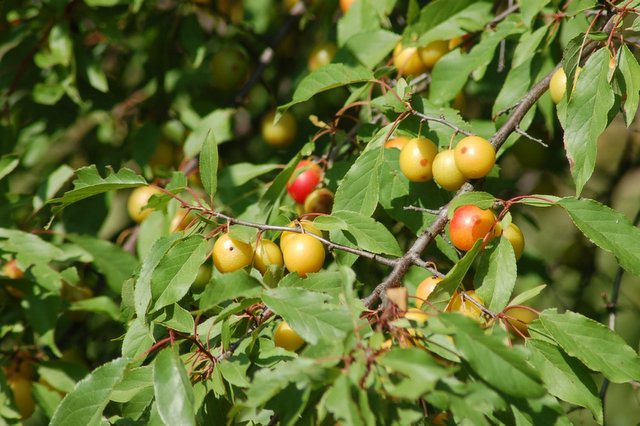
Before the heat wave, the wild plum crop appeared promising. In the last week, most of the fruit have dropped off. Sigh. I was so looking forward to adding wild plum jelly to the pantry shelves. Posted by Picasa

Thursday, July 13, 2006

Wild cherries

If I were 20 feet taller, I could harvest this thick crop of wild cherries. I picked a modest amount from the branches I could reach, but they grow much thicker in the sunny treetops. I've also been picking wild blackberries and the fully ripened deep purple gooseberries. The ripe gooseberries are quite tasty, much better than the green stage that's more commonly used in this country.
Wild berries are small, though. It probably takes me three or four times longer to pick enough for a batch of jam as it would in a cultivated garden of domestic fruit. But ah, the flavors!  Posted by Picasa

Sunday, May 21, 2006

Indian Paintbrush

Just down the road there's a patch of prairie, blooming with native flowers. It's owned by a friendly neighbor who doesn't mind me wandering about, snapping photos. About a week ago, the Indian Paintbrush hit it's prime, and its bright splashes of color dominated the field. This week, the yellows and blues are gradually taking over.

Monday, May 01, 2006

Spring peeper!

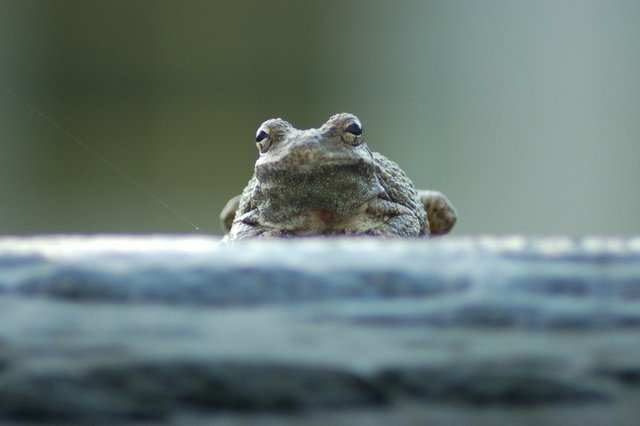
Technically it's a gray treefrog, Missouri's most common species of treefrog. I tracked it by sound to this perch on the rip of our above-ground pool. Since it sounded more like "a birdlike, musical trill" than "a buzzer", I concluded, with the help of the Missouri Department of Conservation's website that my visitor is an eastern gray treefrog (Hyla Versicolor) and not a Cope's gray treefrog (Hyla Chrysoscelis). Judging from the evening chorus, the swampy pond just downhill from the house is frequented by hundreds of eastern gray treefrogs.

Thursday, April 06, 2006

Wild strawberries

Several patches of wild strawberries are blooming in the back pasture. The majority grow among a couple of burnt-out blackberry patches the wildfires cleared this winter. They're also near the cedars, at the edge of a plum thicket, and scattered here and there among the grass. Judging from the number of buds on most plants, this will be a bumper crop year. Just the thought of that intense flavor makes my mouth water. If I'm really lucky and really fast, I might even beat the local wildlife to a few berries when they ripen. Posted by Picasa

Wednesday, March 15, 2006

Natural knots

This thick tangle of vines wraps around two young elm trees and extend up into the treetops. The bark is smooth, unlike wild grapevines nearby. I'm hoping when it leafs out I'll be able to figure out what it is.

Sunday, March 05, 2006

Way over there

The prairie chickens returned to their booming grounds just before sunset a few days ago. My daughter and I watched them for nearly an hour as they made their way across a wheat field and then began their display. One stayed a bit away from the others, keeping watch perhaps for the return of the hawk that had been patrolling the field earlier. Posted by Picasa

Thursday, March 02, 2006

This morning I got up early and drove to the Taberville Prairie conservation area to watch the prairie chickens. Turns out, the current booming grounds are on private property across the road from this lovely piece of prairie. I saw six Greater Prairie Chickens (Tympanuchus cupido pinnatus). I even got one photo with a streak of sunrise and a dark spot that only I can positively identify as a puffed up male Greater Prairie Chicken doing its thing. Yep, sun flares, a splash of early spring wheat, and a brown blur with a white tail fan. Oh well. I'm still excited about my first opportunity to observe this native grouse species in the wild. I stood for a half hour on top the pickup truck toolbox, watching them through the telephoto lens and listening to the thrumming sound the males make when they're trying to impress the hens. It was a successful scouting trip. I have great hopes for future excursions with a better lens, better light, and maybe I'll luck into a viewing spot that doesn't require me to focus directly into the rising sun.

For more information about the Greater Prairie Chicken, check out the Missouri Department of Conservation's website. The Minnesota Prairie Chicken Society has great photos here. Photographer Joel Satore has stunning photos of lesser prairie-chickens booming in Oklahoma on his site. (Search on 'prairie chickens')

Tuesday, November 22, 2005

Don't forget the flashlight

I got sidetracked with a project and didn't get out to the pasture to move the goats until after dark. Not fun when that overgrown pathway is surrounded by thorny locust tree trunks and saplings like this. The goats were most displeased by my tardiness and displayed their tempers in various ways. Once again, I was reminded that there's not much on this earth more stubborn than an old goat. Except me. Posted by Picasa